
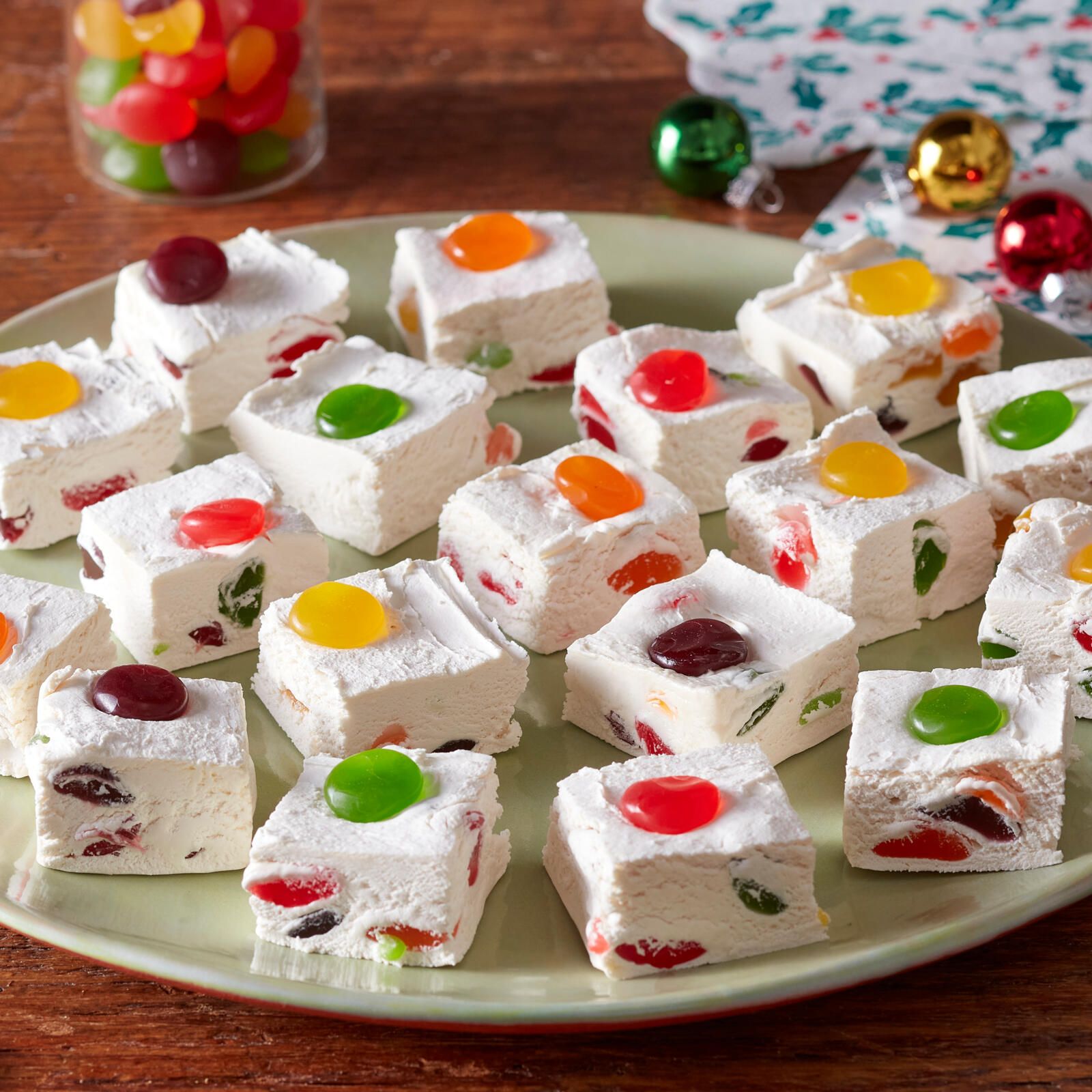
In the world of classic American candies, few treats hold as much ethereal allure as Divinity. It’s a confection that seems to defy its own ingredients—a sweet, billowy cloud that melts on the tongue, leaving behind a trail of vanilla and nostalgia. But when you take this already heavenly creation and stud it with vibrant, jewel-toned fruits and nuts, you elevate it to a centerpiece worthy of any holiday table or special occasion: Jeweled Divinity Candy.
This isn’t just a candy; it’s an edible mosaic, a testament to patience and precision, and a beloved heirloom recipe passed down through generations. It’s the taste of holiday anticipation and the glittering star of a cookie tray.
The Heritage of Divinity: A Candy Born of Weather and Whimsy
To understand Jeweled Divinity is to first appreciate its humble yet finicky origins. Divinity is a type of nougat, belonging to the family of whipped sugar syrups. Its roots are deeply planted in the American South, with many claiming it was a creation of the early 20th century, possibly linked to the popularization of corn syrup as a stable, affordable sweetener.
The name itself, “divinity,” is a nod to its otherworldly texture—light, airy, and impossibly white, as if a piece of heaven had drifted down to the confectioner’s kitchen. However, this divine nature comes with a notorious caveat: it is profoundly susceptible to humidity.
Traditional divinity is a fair-weather friend. Attempting to make it on a rainy, muggy day is a recipe for sticky, soupy disappointment. The sugar syrup absorbs moisture from the air, preventing it from holding its stiff, peaked structure. This meteorological dependency is why divinity is most famously associated with the crisp, dry air of autumn and winter, particularly around Christmas.
Deconstructing the “Jewels”: More Than Just Color
While classic divinity is a pure, snowy white, the “jeweled” version is a celebration of color and texture. The “jewels” typically consist of:
- Candied Cherries: The quintessential jewel. Their vibrant red and green provide a stunning contrast against the white backdrop. They offer a chewy, sweet, and slightly tart burst of flavor.
- Pecans or Walnuts: Toasted and chopped, these nuts provide a essential earthy, buttery crunch that balances the candy’s intense sweetness. They are the “gold” and “brown topaz” of the mosaic.
- Other Glittering Add-Ins: The canvas is yours to paint. Some recipes include:
- Candied Pineapple: For a tropical, chewy sweetness and a yellow hue.
- Dried Cranberries or Apricots: For a tangy, ruby-red or orange sparkle.
- Pistachios: Their brilliant green adds another layer of color and a distinct, savory nuttiness.
The key is to chop all additions to a uniform, bite-sized scale so they distribute evenly and are easy to eat.
The Science of the Cloud: Understanding the Process
Divinity is not a candy you can make on a whim. It requires attention and respect for the chemical processes at play. At its core, divinity is a meringue—but instead of being stabilized with a hot sugar syrup like Italian meringue, it uses a syrup of sugar and corn syrup cooked to the “soft-ball stage” (240°F / 115°C).
- Corn Syrup’s Role: While some may hesitate to use it, corn syrup is non-negotiable in a reliable divinity recipe. Its purpose is to prevent the sucrose (granulated sugar) from crystallizing. It ensures the final product is smooth and creamy, not grainy.
- The Soft-Ball Stage: Cooking the syrup to precisely 240°F is critical. A lower temperature results in a syrup that’s too soft, leading to divinity that never sets. A higher temperature makes the syrup too hard, causing threads of brittle candy to form when you try to beat it.
- The “Thread Test”: As you pour the hot syrup into the whipped egg whites, it should form a thin, 6-8 inch thread that mounds on itself. This visual cue is just as important as the thermometer reading.
The Ultimate Jeweled Divinity Candy Recipe
This recipe is a detailed guide, designed to set you up for success. Read it through completely before you begin.
Yields: About 40-50 pieces
Prep Time: 30 minutes
Cook Time: 20 minutes
Setting Time: 2+ hours
Ingredients:
- 2 ½ cups (500g) granulated sugar
- ½ cup (120ml) light corn syrup
- ½ cup (120ml) water
- 2 large egg whites, at room temperature
- ¼ teaspoon salt
- 1 teaspoon pure vanilla extract
- 1 cup (approx. 150g) mixed “jewels” (e.g., ½ cup chopped red & green candied cherries, ½ cup toasted pecans, chopped)
Essential Equipment:
- A reliable candy Thermometer (this is non-negotiable for beginners)
- Stand mixer or a powerful hand mixer
- Heavy-bottomed saucepan (to prevent hot spots and burning)
- Silicone spatula
Step-by-Step Instructions: A Dance of Precision
Step 1: The Mise en Place (Preparation)
This is the most crucial step. Once the sugar syrup is cooking, there is no time to pause.
- Prepare the Pan: Line two baking sheets with parchment paper or wax paper. Do not use foil, as the candy can stick.
- Chop the Jewels: Chop your cherries, nuts, and any other fruits to a uniform, small dice. Set them aside in a bowl.
- Separate the Eggs: Ensure your egg whites are in the clean, grease-free bowl of your stand mixer. Even a speck of yolk or grease can prevent the whites from whipping properly. Add the salt to the egg whites.
- Combine the Syrup: In your heavy-bottomed saucepan, combine the granulated sugar, corn syrup, and water. Stir just until the sugar is moistened. From this point forward, do not stir the syrup. Insert your candy thermometer.
Step 2: The Synchronized Start
- Place the saucepan over medium-high heat and bring the syrup to a boil.
- Just as the syrup reaches 230°F (110°C), begin whipping the egg whites and salt on medium-high speed. The goal is to have the egg whites at stiff, glossy peaks just as the syrup reaches 240°F (115°C).
Step 3: The Critical Combine
- Once the syrup hits exactly 240°F (the soft-ball stage), immediately remove it from the heat.
- With the mixer running on medium speed, slowly and carefully pour the hot syrup in a thin, steady stream down the side of the bowl into the whipped egg whites. Avoid pouring directly onto the whisk, as it will splatter.
- After all the syrup is added, increase the mixer speed to high. Beat for 5-10 minutes. You will witness a magical transformation: the mixture will thicken, become opaque, and hold very stiff, glossy peaks. When you lift the beater, the “thread” of candy should mound on itself.
Step 4: The Final Flourish
- When the candy is thick and holds its shape, reduce the mixer speed to low and beat in the vanilla extract.
- Remove the bowl from the mixer. Now, work quickly but carefully. Using a sturdy silicone spatula, gently fold in the chopped jewels and nuts until they are evenly distributed.
Step 5: Forming the Clouds
- Using two spoons (or a small cookie scoop), quickly drop heaping teaspoonfuls of the divinity onto your prepared parchment-lined sheets. If the candy becomes too stiff to dollop, add a few drops of very hot water and stir gently to loosen it.
- If you desire a more polished look, you can lightly butter your fingers and shape the dollops into neater mounds.
Step 6: The Patient Wait
Allow the divinity candies to rest at room temperature for at least 2 hours, or until they are completely firm and no longer sticky to the touch. Do not refrigerate, as this can introduce moisture and make them weep.
Troubleshooting: Salvaging Your Divinity
- My divinity is runny and won’t hold peaks: The humidity was likely too high, the syrup didn’t reach 240°F, or the egg whites weren’t whipped sufficiently. You can try beating it longer. If it absolutely will not set, you have a delicious ice cream topping!
- My divinity is grainy: The sugar crystallized. This usually happens if the syrup was stirred while boiling or if the corn syrup was omitted.
- My divinity is too stiff or forms threads: The syrup was cooked too high (past 240°F). Next time, remove it from the heat the second it hits the correct temperature.
Storing Your Edible Jewels
Store completely set divinity in a single layer in an airtight container at room temperature. Place sheets of wax paper between layers. They keep best in a cool, dry place for up to 2 weeks.
In Conclusion
Jeweled Divinity Candy is more than a recipe; it’s an experience. It connects us to the past, challenges our skills in the present, and creates a beautiful, delicious memory for the future. When you place a glistening tray of these candies on your table, you’re not just serving a sweet—you’re offering a piece of culinary art, a cloud of sweetness studded with jewels, a truly divine creation.
